
Introduction
The Sri Lakshmi Narasimhar Temple stands as one of South India’s most remarkable and ancient Vaishnava temples, nestled in the small village of Keezhapavur in the Tirunelveli district of Tamil Nadu. Often referred to as “Dhakshina Ahobila” (South Ahobila), this temple holds immense spiritual and historical significance, housing a rare and fierce manifestation of Lord Vishnu as Narasimha. While many temples showcase the gentle or benevolent aspects of the divine, the Lakshmi Narasimhar Temple uniquely celebrates the fierce, protective, and destructive power of the Almighty—depicted in the striking and awe-inspiring form of the Ugra Narasimha (the terrible Narasimha).
Historical Background
Age and Antiquity
The Sri Lakshmi Narasimhar Temple is estimated to be between 1,000 to 2,000 years old, with various sources citing ages ranging from 500 to 1,500 years. The temple’s true antiquity is confirmed by substantial historical evidence discovered during renovation work. Inscriptions belonging to the Pandya and Chola kingdoms have been unearthed within the temple premises, establishing its significance during these glorious periods of South Indian history. These inscriptions attest to the temple’s continuous worship and its importance as a major pilgrimage site during the medieval period.
The temple’s construction and development likely occurred during the era of the Pandya and Chola dynasties, periods when Vaishnavism was flourishing in Tamil Nadu. The architectural style and sculptural elements suggest influences from multiple historical periods, reflecting the temple’s continuous evolution and renovation over the centuries.
Geographic Location and Accessibility
Keezhapavur is a small, tranquil village located in the Alangulam Taluk of Tirunelveli district, situated on the route between Tenkasi and Tirunelveli. The village’s precise location is:
- 2 kilometers from Pavoorchatram (which has a railway station)
- 5 kilometers from Pavur Chattiram on the Surandai road
- 17 kilometers from Tenkasi
- 51 kilometers from Tirunelveli city
- 643 kilometers from Chennai
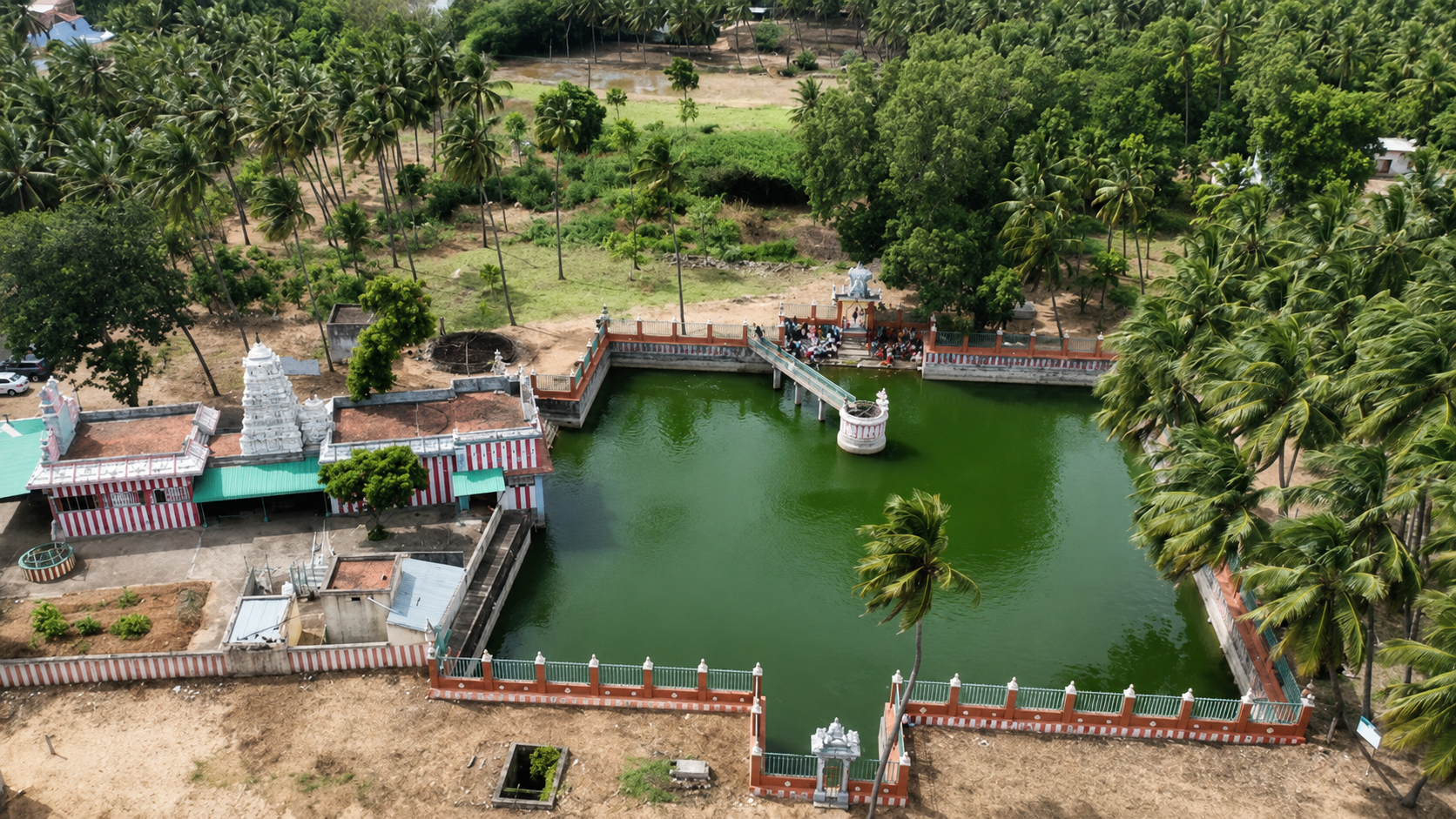
The temple is nestled in lush green surroundings, surrounded by coconut groves and cultivable agricultural lands. The natural beauty of the region, with its verdant landscape, adds to the spiritual ambiance of the pilgrimage site. However, the roads leading to the temple are narrow, reflecting the rural character of the village and requiring visitors to navigate carefully to reach this sacred sanctuary.
Transportation Details
Railway Connections:
- Nearest Railway Station: Pavoorchatram Railway Station (2 km away)
- Secondary Railway Station: Tenkasi (17 km away)
Air Connections:
- Nearest Airports: Madurai International Airport (approximately 200 km) and Thiruvananthapuram International Airport (118 km away)
Road Access: Visitors can reach the temple via state highways connecting Tenkasi and Tirunelveli. The drive through Tamil Nadu’s verdant countryside offers scenic views of the region’s natural landscape.
Mythological Significance
The Origin Legend
The origin of the Sri Lakshmi Narasimhar Temple is rooted in beautiful Hindu mythology, specifically connected to the famous Narasimha Avatar—one of the ten primary incarnations of Lord Vishnu. According to the temple’s legend and Puranic traditions:
The great Maharishi Kashyapa (the father of all creatures according to Hindu mythology), along with the celestial sage Narada, the god Varuna, and other devas (celestial beings), desired intensely to witness the Narasimha avatar of Lord Vishnu. These extraordinary beings performed rigorous penance and sought the blessings of the Supreme Lord Hari (Vishnu).
Lord Vishnu, pleased with their devotion, appeared to them and instructed them to proceed to the banks of the Chitra River, which flows near the sacred Pothigai Hills in this region. He promised that they would receive the divine darshan (vision) of His Narasimha form if they continued their penance at this auspicious location. Following the Lord’s divine command, these celestial beings came to Keezhapavur and performed an intense spiritual penance for several years.
As the heat and power of their penance intensified, reaching even the celestial abodes of Vaikunta (the divine realm of Vishnu), the Lord finally responded. The legend speaks of a moment during Pradosha time (the auspicious twilight hours between 4:30 PM and 6:00 PM) when these sages heard the mighty roaring of a lion emanating from the heavens. This thunderous roar, which seemed to shake the very earth, was the manifestation of the Lord’s Narasimha form in all its terrible and awesome power. The sages, overwhelmed by the divine presence and the magnificence of the vision, lost themselves in ecstatic meditation and received the darshan they so desperately sought.
The historical record of this phenomenon is preserved in local folklore. Even today, elderly residents of Keezhapavur speak of the ancient tradition of hearing the roaring of a male lion, particularly during midnight hours, believed to have originated from the sanctum sanctorum of the temple. This sound phenomenon, mentioned repeatedly in temple accounts across centuries, is attributed to the fierce and omnipotent nature of the presiding deity and has become an integral part of the temple’s mystique.
The Narasimha Avatar Connection
The Narasimha Avatar holds special significance in Hindu theology and devotional practices. Narasimha, whose name literally means “human-lion” (Nara = human, Simha = lion), represents the divine incarnation taken by Lord Vishnu to vanquish the powerful demon Hiranyakashipu and protect his devoted follower Prahlada. This avatar embodies the principle that evil, no matter how powerful or protected, cannot escape divine justice.
The Keezhapavur temple’s depiction of Narasimha as the fierce destroyer of evil connects devotees to this fundamental spiritual principle—that the divine has both merciful and wrathful aspects, and that justice is an essential component of divine action. The temple thus serves not merely as a place of worship but as a profound meditation on the nature of dharma (righteousness) and the protection of the virtuous.
Temple Architecture and Deities
Structural Overview
Despite being an ancient temple of significant spiritual importance, the Sri Lakshmi Narasimhar Temple maintains a modest, intimate architectural scale. The temple consists of several interconnected shrines, each with its own distinct purpose and sanctity. The overall design reflects cave-temple architecture, with relatively compact sanctum sanctorums that create an atmosphere of profound spiritual intimacy.
The Welcome Gateway
The temple features an elegant east-facing welcome arch (gopuram gateway) that serves as the primary entrance. This entrance is architecturally significant, displaying traditional Hindu temple design elements:
- Central Figure: Sri Prasanna Venkatesa Perumal is depicted in the center of the welcome arch
- Flanking Figures: The presiding deity is flanked by Sri Devi (the goddess of prosperity) and Bhoo Devi (the earth goddess), representing different aspects of divine grace
- Ornamental Elements: On either side of the welcome arch stand two Garudalwars (sculptures depicting Garuda, the divine eagle vehicle of Vishnu), a Sangu (conch shell symbolizing the creative sound), and a Chakra (discus symbolizing divine power)
These elements collectively symbolize the divine protection, cosmic order, and sacred vibration that characterize the Lord’s presence within the temple.
The Main Shrine: Prasanna Venkatesa Perumal
Though the temple is popularly known as the Lakshmi Narasimhar Temple, the primary deity of the main shrine is actually Prasanna Venkatesa Perumal (the gracious, merciful form of Venkatachalapathy). This beautiful form of Lord Vishnu faces eastward in the sanctum sanctorum, expressing the ancient principle that eastern orientation invokes the rising sun, symbolizing new beginnings and divine illumination.
Key Features of Prasanna Venkatesa Perumal’s Shrine:
- Appearance: East-facing orientation, seated in a graceful posture
- Divine Consort: Accompanied by Goddess Alarmel Mangai (also known as Alarmelmangai Thaayar), Lakshmi, who represents divine grace and prosperity
- Urchavamoorthy: An additional vigraha (idol) of the deity in standing form is housed within the sanctum sanctorum, allowing devotees to contemplate different divine aspects
Before the main shrine stands a magnificent Garudalwar (sculpture of Garuda), where devotees pay their respects to this vehicle of divine purpose.
The Narasimha Shrine
Facing westward toward the sacred Pushkarani (temple tank), the most striking and powerful feature of the temple is the Ugra Narasimha (Fierce Narasimha) Shrine. This representation is extraordinarily rare and theologically profound. Unlike many temples that depict Narasimha in a seated pose, the Keezhapavur temple showcases Narasimha in a particularly fierce and dramatic moment of divine action.
The Iconic Depiction:
The Narasimha murti (sacred image) at Keezhapavur is rendered with remarkable sculptural artistry and theological significance:
- Multiple Arms: The deity is depicted with 16 hands, each serving a specific symbolic purpose
- The Central Action: Demon Hiranyakashipu, the embodiment of pride and evil, is positioned on the Lord’s left thigh, literally on the verge of being destroyed
- Destructive Power: Four hands are actively engaged in tearing open the belly of Hiranyakashipu in the act of vanquishing him
- Divine Weapons: Two hands are pulling the vital veins and organs from the demon, while the remaining hands grasp 12 different weapons including:
- His characteristic discus (Chakra)
- Various weapons of divine retribution
- Symbols of cosmic power and protection
The Surrounding Divine Presence:
The sculptural composition includes figures of celestial beings witnessing this divine act of justice:
- Maharshi Kashyapa and Maharshi Narada stand in devotion
- The God Varuna witnesses the cosmic justice
- Sukosha and other celestial beings are depicted in postures of worship and amazement
Symbolic Elements:
Above the Lord’s head hovers an umbrella symbolizing Dharma (cosmic order and righteousness), indicating that this fierce destruction is not mere violence but the upholding of cosmic law. On either side are two Ven Samaram (ceremonial fans), further emphasizing the Lord’s sovereignty and glory.
Theological Significance:
This representation is theologically powerful because it illustrates the principle that divine protection of the righteous inevitably involves the destruction of evil. The simultaneous presence of both creative and destructive forces represents the complete nature of the Supreme Being—not limited to gentleness alone, but encompassing all necessary aspects of cosmic governance.
The Sacred Tank (Pushkarani)
A remarkable feature of the temple is its Narasimha Theertham (the sacred water tank), which is unusually large compared to the relatively modest temple structure. This creates an interesting architectural balance:
- Size: The Pushkarani is notably expansive, proportionally much larger than the temple itself
- Purpose: According to temple lore, the sacred tank exists to provide cooling relief to the Lord after the intense battle against Hiranyakashipu
- Architecture: The tank features a beautiful Welcome Arch and a Vasantha Mandapam (a pavilion) in its center, making it both a sacred and architectural feature
- Spiritual Significance: The water of this tank is considered highly sacred and is believed to possess purifying and healing properties
Additional Structures
The temple complex includes several support structures:
- Madapalli: A kitchen facility for preparing and distributing sacred food offerings
- Yaaga Mandapam: A pavilion designed for performing Vedic fire rituals and sacred ceremonies, emphasizing the temple’s commitment to maintaining ancient Vedic traditions
- Sanctum Sanctorum Features: Though small in size, capable of accommodating approximately 50 devotees at a time, the sanctum is designed for intimate darshan experiences
Sacred Tree (Sthala Vruksham)
The Bilvam tree (also known as the wood apple tree) serves as the temple’s sacred tree (Sthala Vruksham). In Hindu tradition, specific trees are considered especially auspicious:
- Botanical Significance: The Bilvam tree has been used in Hindu rituals for millennia
- Ritual Importance: Leaves of this tree are considered highly sacred and are used in pujas and worship rituals
- Spiritual Association: The tree is believed to be a manifestation of divine energy and is never cut down at temples
The Divine Form: Why “Lakshmi Narasimhar”?
One of the most intriguing theological aspects of this temple is the paradox of its name. The temple is called the Sri Lakshmi Narasimhar Temple, yet there is notably no separate shrine or murti (image) of Goddess Lakshmi in the temple. This apparent contradiction is resolved through a beautiful theological interpretation:
The Concept of Lakshmi Within Narasimha’s Heart
Hindu philosophy teaches that Goddess Lakshmi, the supreme manifestation of divine grace, prosperity, and compassionate power, eternally resides in the heart (Hridayam) of Lord Narasimha. This concept, known as Hridaya Vasini Lakshmi (Lakshmi dwelling in the heart), suggests that:
- The ferocious power of Narasimha’s destructive force is always tempered and guided by Lakshmi’s grace
- The destruction of evil is ultimately an act of divine mercy toward the righteous
- Even in the most terrible aspect of divinity, compassion and grace are intrinsically present
This theology reconciles the apparent contradiction between Narasimha’s fierce form and the name of the goddess of grace, suggesting that true power is always guided by compassion. Therefore, devotees who worship Narasimha at this temple are simultaneously invoking the blessings of Lakshmi, even without seeing her in a separate physical form.
Spiritual Significance and Beliefs
Beliefs and Prayers
The Sri Lakshmi Narasimhar Temple has attracted devotees for centuries due to its powerful spiritual efficacy. Devotees visit this temple seeking:
- Relief from Debt Burdens: One of the primary reasons devotees visit is to seek liberation from financial difficulties and debts. The fierce power of Narasimha is invoked to destroy the obstacles and negative forces that bind devotees to financial hardship.
- Resolution of Marriage Obstacles: The temple is considered especially powerful for those facing delays in marriage due to astrological or circumstantial reasons. The protective aspect of Narasimha is believed to clear obstacles preventing matrimonial unions.
- Courage and Strength: Devotees seek the valor and fearlessness of Narasimha to overcome personal challenges and adversities.
- Freedom from Diseases: The healing and protective aspects of the divine are invoked for health and wellness.
- Relief from Planetary Afflictions: Devotees seek remedies for adverse astrological planetary influences through the Lord’s grace.
- Bondage Liberation: Spiritual seekers come to seek freedom from karmic bondage and cycles of samsara (the cycle of birth and death).
Sacred Mantras
Two primary Sanskrit mantras are associated with the worship at this temple:
1. Achutham Keysavam Mantra:
Achutham Keysavam Rama Narayanam Krishna Damodaram Vasudevam Harim Shridharam Madhavam Gopika Vallabham Janaki Nayakam Ramachandram Bhajey
Meaning: “Oh Lord who cannot be destroyed (Achuta), who is known by many names including Keshava, Rama, Narayana, Krishna, Damodara, Vasudeva, Hari, Shridhar, Madhava, and the beloved of the Gopis, and the consort of Janaki, let me continuously remember and sing your divine names.”
This mantra emphasizes the multiple forms and names of Vishnu, suggesting the infinite nature of the divine that transcends any single form.
2. Vasudeva Sutham Devam Mantra:
Vasudeva Sutham Devam Kamsa Chanoora Mardhanam Devaki Paramanandham Krishnam Vande Jagathgurum
Meaning: “I bow to you, O Krishna, the ultimate spiritual teacher of the universe, son of Vasudeva and Devaki, the destroyer of the demons Kamsa and Chanur, and the supreme source of joy for all beings.”
Religious Observances and Festivals
Festival Calendar
The Sri Lakshmi Narasimhar Temple celebrates numerous festivals throughout the year, each carrying profound spiritual significance:
1. Vaikunda Ekadasi (December-January)
This is one of the most important festivals at the temple. Ekadasi refers to the 11th day in the lunar fortnight, considered especially auspicious for Vishnu worship. Vaikunda Ekadasi specifically celebrates the opening of the gates of Vaikunta (the celestial abode of Vishnu). Devotees observe fasting, perform special pujas, and engage in continuous chanting of divine names and mantras. The festival draws large gatherings of pilgrims.
2. Narasimha Jayanthi
Celebrating the birth anniversary of Lord Narasimha, this festival is particularly significant at this temple. The day involves:
- Special worship rituals performed with heightened ceremonial grandeur
- Abhisheka (ritual bathing) of the deity with sacred substances
- Grand processions and celebrations
- Continuous chanting of prayers honoring the Narasimha avatar
- Large distribution of sacred food offerings (prasadam) to all devotees
3. Purattasi Saturdays (September-October)
The month of Purattasi (September-October in the Tamil calendar) is considered particularly sacred for Perumal (Vishnu) worship. On all Saturdays during this month, the temple conducts special worship rituals. The festival demonstrates the devotional calendar’s integration with natural seasonal cycles.
4. Swathi Star Days
In the Tamil astrological calendar, Swathi Naksatra (the Swathi star) is considered especially auspicious for Vishnu worship. On days when this star is in ascendance, the temple conducts special pujas. Devotees visit the temple en masse, and many perform ritualistic practices like abhisheka with milk and tender coconut water, seeking blessings and protection.
5. Pradosham
Occurring twice monthly (on the 13th day after both the new moon and full moon), Pradosham is a twilight period (4:30 PM to 6:00 PM) considered especially potent for spiritual practices. During Pradosham, the temple conducts:
- Special worship rituals with elaborate ceremonies
- Circumambulations of the temple by devotees
- Group chanting of mantras
- Abhisheka rituals with milk, honey, ghee, and other sacred substances
- Spiritual discourse and teaching
Daily Worship Schedule
Morning Hours: 7:30 AM to 11:30 AM
- Early morning is considered the most auspicious time for darshan
- The deity is awakened, adorned, and offered prayers
- These hours attract devotees seeking spiritual purity and blessing
Evening Hours: 5:00 PM to 8:00 PM (sometimes extended to 8:30 PM)
- The temple reopens for evening worship
- Devotees gather to perform prayers and seek evening blessings
- This period, which includes Pradosham time, is particularly auspicious
Devotional Practices and Customs
Unique Devotional Practices
The Sri Lakshmi Narasimhar Temple is famous for several distinctive devotional practices that have been maintained for centuries:
Circumambulation Ritual
One of the most significant practices at this temple is the circumambulation of the temple pradaram (outer corridor) 16 times, performed by devotees seeking specific blessings:
- Significance of 16: The number 16 is considered sacred in Hindu numerology, representing completeness and perfection. The 16 hands of the Narasimha image also carry this symbolism.
- Expected Benefits: Those who perform this ritual with sincere devotion reportedly experience:
- Relief from debt and financial burdens
- Dissolution of marriage obstacles
- Receipt of divine blessings for marital happiness and prosperity
- General spiritual advancement and grace
Prasadam Offerings
The temple has a unique and refreshing tradition of offering prasadam to devotees:
- Panagam: A sweetened drink made from jaggery (gur) and lemon, known locally as Panagam, is offered to devotees as sacred food. This drink is believed to have cooling and revitalizing properties, and its sweetness symbolizes the sweetness of divine grace
- Timing: Particularly offered during hot months and after devotees complete their prayers
- Spiritual Significance: The offering of this simple but nourishing drink represents the temple’s commitment to caring for the physical well-being of pilgrims alongside their spiritual nourishment
Abhisheka Practices
Devotees perform ritualistic bathing of the deity during auspicious times:
- Milk abhisheka (ritual bathing with milk) is offered during Swathi star days
- Tender coconut water is used to anoint the deity during special occasions
- These practices symbolize cooling the fierce form of Narasimha with cooling substances, invoking the metaphorical “cooling” of the Lord’s wrath through devotion and compassion
The Phenomenon of the Roaring Lion
One of the most intriguing and mystical aspects of the temple is the historical account of a roaring sound heard from the temple premises:
Historical Documentation
- Local tradition and temple records speak of a phenomenon where the roaring of a male lion was historically heard, particularly during midnight hours
- This sound was believed to emanate directly from the sanctum sanctorum of the temple
- The phenomenon was confirmed by multiple observers across centuries, suggesting its consistency rather than a singular event
- Even in modern times, elderly residents of Keezhapavur speak of this ancient tradition
Theological Interpretation
From a theological perspective, this phenomenon is understood as:
- A manifestation of the omnipotent and awesome power of Lord Narasimha
- The continuing presence and vigilance of the deity protecting the sacred space
- A test and validation of faith for sincere devotees
- A reminder of the universe’s mysterious and miraculous dimensions that transcend ordinary human understanding
This phenomenon adds to the temple’s mystique and has made it a subject of both spiritual reverence and intellectual curiosity.
Accessibility and Visitor Information
Contact Details
- Temple Authority Contact: Anandhachariar
- Phone: +91 94423 30643
- Address: Sri Lakshmi Narasimhar Temple, Keezhapavur, Alangulam Taluk, Tirunelveli District, Tamil Nadu – 627806
Accommodation Options
In Tirunelveli:
- Hotel Aryas: +91-462-233 9002
- Hotel Janakiram: +91-462-233 1941
- Hotel Bharani: +91-462-233 3235
- Hotel Nainar: +91-462-233 9312
In Tenkasi Area:
- Hotel Sountharyaa
- Hotel Krishna Tourist Home
- Various guesthouses and ashrams
In Courtallam (22 km away):
- Five Falls Resort Courtallam
- The Mount View Castle
- Various budget and mid-range hotels
Nearby Temples
The region around Keezhapavur is rich in temple heritage. Nearby temples include:
- Sri Kasi Viswanathar Temple, Tenkasi – A major Shaiva temple dedicated to Lord Shiva
- Sri Subramaniya Swamy Temple, Nettur – Dedicated to Murugan, the son of Shiva
- Sri Arthanareeswarar Temple, Vasudevanallur – A Shaiva temple with ancient origins
- Arulmigu Thirumalai Kumaraswamy Temple, Panpoli – Another Vaishnava shrine
- Arulmigu Sankaranarayanaswamy Temple, Sankarankovil – Dedicated to Vishnu
- Sri Sadasivamurthy Temple, Puliyarai – A Shaiva shrine
- Sri Navaneetha Krishnaswamy Temple, Puliyarai – A Vaishnava temple
This concentration of temples makes the region a major pilgrimage circuit for Hindu devotees interested in both Shaivism and Vaishnavism.
The Broader Context: Dhakshina Ahobila
The Significance of “South Ahobila”
The Sri Lakshmi Narasimhar Temple is also known as Dhakshina Ahobila (South Ahobila), a title that places it within a significant theological and geographical context:
- The Original Ahobila: The primary Ahobila temple is located in Andhra Pradesh in the Nellore district and is one of the most important Vaishnava pilgrimage centers, believed to be established over 2000 years ago
- Regional Significance: The designation of Keezhapavur as “South Ahobila” suggests its historical and spiritual importance as a parallel or alternative pilgrimage site for those unable to reach the original Ahobila
- Theological Connection: Both temples celebrate the Narasimha avatar and maintain similar devotional practices and spiritual philosophies
This connection indicates that the Keezhapavur temple was historically as important to South Indian Vaishnavism as the more famous Ahobila temple in Andhra Pradesh.
Why This Temple is Unique
The Sri Lakshmi Narasimhar Temple distinguishes itself through several remarkable features:
1. The Rare 16-Handed Narasimha
While Narasimha depictions are found in various temples across India, the specific representation with 16 hands engaged in the act of destroying Hiranyakashipu is relatively rare. This elaborate sculptural theology communicates sophisticated philosophical concepts about cosmic power and divine justice.
2. Integration of Cave Temple Architecture
The small sanctum sanctorum design, reminiscent of cave temples, creates an intimate atmosphere unique among temple experiences, allowing devotees to feel spiritually proximate to the deity.
3. The Disproportionately Large Sacred Tank
The significantly larger Pushkarani compared to the temple structure itself is architecturally distinctive and carries symbolic meaning about the vastness of divine grace.
4. The Theological Unity of Narasimha and Lakshmi
The philosophical concept of Lakshmi residing within Narasimha’s heart offers a sophisticated resolution to the apparent contradiction between fierceness and grace, making this temple a center for understanding non-dualistic Hindu theology.
5. Historical Continuity
The discovery of Pandya and Chola inscriptions during renovation, combined with the temple’s continuous operation and reverence through multiple historical periods, makes it a living bridge between ancient and modern Hindu spirituality.
Practical Tips for Pilgrims
Best Times to Visit
- Peak Season: October to March (pleasant weather)
- Festival Seasons: December-January (Vaikunda Ekadasi), September-October (Purattasi), for enhanced spiritual atmosphere and larger congregations
- Avoid: April to June (extreme heat)
What to Bring
- Comfortable walking shoes (roads are narrow and uneven in places)
- Light, respectful clothing (temples prefer modest dress)
- Water and snacks for the journey to this remote village
- Camera/phone for documentation (verify if photography is permitted)
Dress Code
- Women: Saree or traditional dress, or modest Western clothing
- Men: Dhoti, simple pants, or shirts
- Avoid shorts and sleeveless tops
- Shoes must be removed before entering sanctum sanctorum
Photography Permissions
Verify with temple authorities regarding photography permissions, as some temples restrict photography inside the sanctum sanctorum to preserve sanctity.
Etiquette
- Circumambulate temples clockwise (keeping the deity to your right)
- Maintain silence in sacred areas
- Accept prasadam with respect
- Do not touch deity images or ritual implements without permission
Conclusion
The Sri Lakshmi Narasimhar Temple in Keezhapavur stands as a remarkable testament to Tamil Nadu’s rich spiritual heritage. More than merely a religious building, it represents centuries of philosophical thought about the nature of divinity, the cosmic battle between good and evil, and the ultimate triumph of righteousness. The temple’s unique combination of ancient history, extraordinary mythology, distinctive architecture, and powerful spiritual practices makes it one of South India’s most significant pilgrimage destinations, particularly for those seeking to understand the more complex and multifaceted aspects of Hindu theology and devotional practice.
Whether one visits as a tourist interested in architectural heritage, a scholar studying Hindu philosophy, or a devotee seeking spiritual blessings, the Sri Lakshmi Narasimhar Temple offers profound experiences and insights that resonate far beyond the small village of Keezhapavur, touching the eternal human quest for understanding the sacred and the divine.