
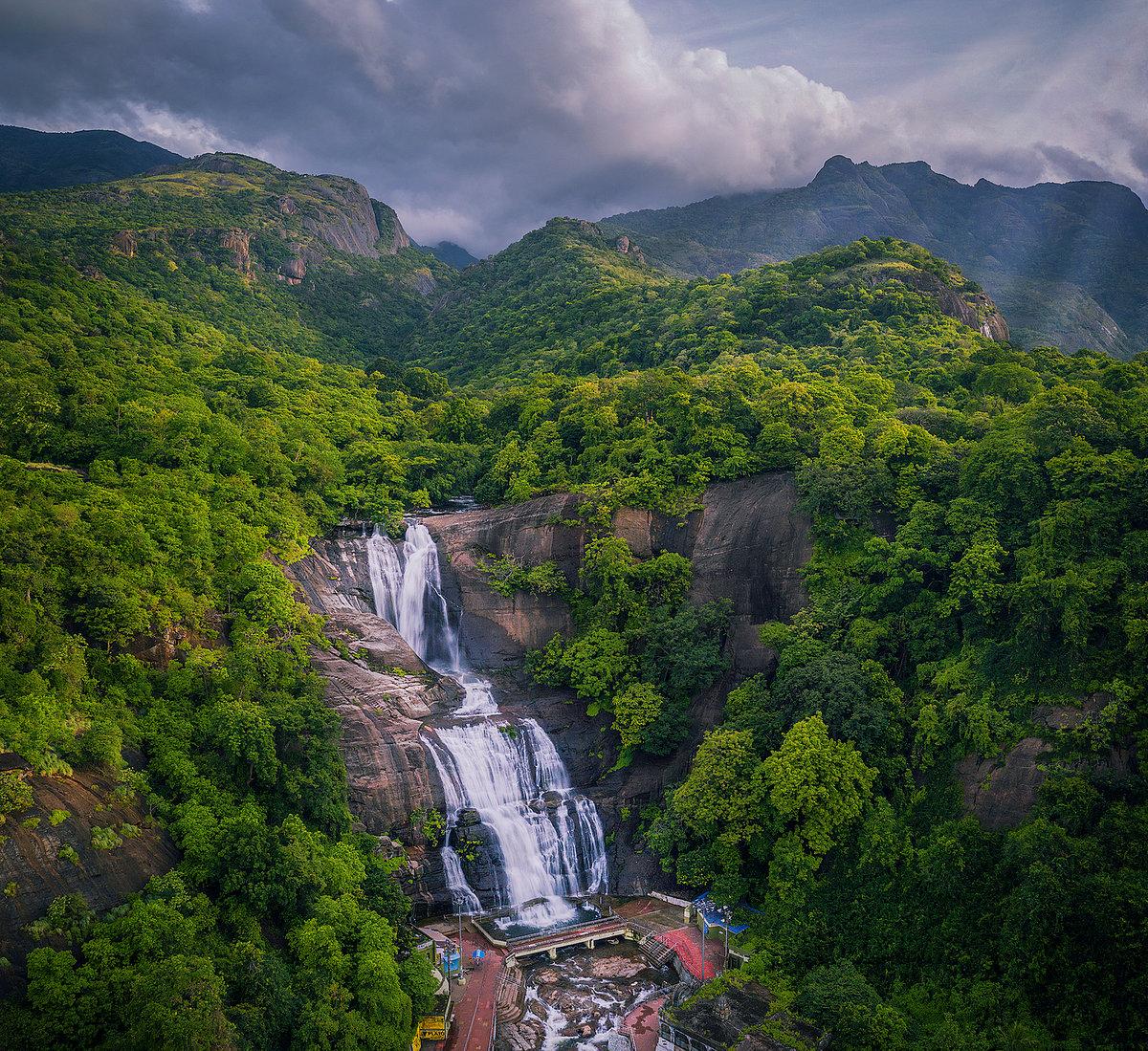
The Main Falls at Courtallam, known locally as Peraruvi, is a 60-meter cascade on the Chittar River that has drawn pilgrims, poets, and health seekers for centuries. Its story weaves together a Hindu creation myth involving the sage Agastya, references in 18th-century Tamil dance drama, a colonial-era transformation into a British sanatorium, and ongoing legal battles to protect ancient rock carvings at the site.
Mythological Origin: The Agastya Legend
The falls are inseparable from the Kutralanathar Temple, a Shiva shrine shaped like a conch shell. Local tradition holds that Lord Shiva sent the sage Agastya to the south to balance the earth during his wedding to Parvati. When Agastya arrived in the region, he transformed what was originally a Vishnu temple into a Shiva temple. The Main Falls are said to have originated at the exact spot where Shiva’s presence was established through this act.
This is not a simple folk tale. The temple’s conch-shaped sanctum is an architectural fact that reinforces the mythology. Pilgrims bathe in the falls before entering the temple, following a ritual sequence that has continued for centuries. The water itself is considered sanctified by the deity’s proximity, which is why even today visitors approach the falls with a reverence that goes beyond tourism.
Literary Roots: The Thirukutrala Kuravanji
The most significant literary work tied to the falls is the Thirukutrala Kuravanji, an 18th-century dance drama written by Thirikooda Rasappa Kavirayar. This is not a minor footnote. The work is a full-length poetic composition that describes the landscape, the falls, and the local Kurinji (hill) culture in vivid detail.
The plot follows a young woman who falls in love with Lord Shiva as the deity of Kutralam. She consults a fortune-teller from the Kurinji tribe, who describes the beauty of the region and the falls. The drama was performed as a temple ritual, and its verses contain some of the earliest written descriptions of the Main Falls’ sound, spray, and the surrounding vegetation. Earlier references also appear in Sangam-era Tamil poetry, though those are less specific to the falls themselves.
British Colonial Period: The Spa of the South
The British discovery of Courtallam in the 19th century changed the falls from a local pilgrimage site into a regional health destination. British officers stationed in the Madras Presidency noticed that the water had therapeutic effects on skin conditions and joint pain. They built bungalows, a rest house, and pathways to the falls, marketing Courtallam as a sanatorium for officers recovering from tropical illnesses.
The nickname “Spa of the South” dates from this period. The British compared the falls to European spa towns like Baden-Baden and Vichy, though the comparison was more promotional than accurate. What was real was the water’s mineral content. The Chittar River flows through dense forests of the Western Ghats, where the water absorbs compounds from herbs, roots, and mineral deposits. The British commissioned early chemical analyses that confirmed the presence of sulfur, calcium, and magnesium compounds.
What Makes the Water Therapeutic
The water at Main Falls is not just rainwater. It flows over a specific geological formation in the Western Ghats, picking up minerals from the rocks and organic compounds from the surrounding forest. The area is rich in Ayurvedic plants, and the water absorbs trace amounts of their active compounds as it cascades down.
The falls also have a unique physical feature: a 19-meter-deep natural pool called Pongumakadal at the base. This crater interrupts the falling water’s force, reducing the impact enough that bathers can stand directly under the cascade without injury. This is not common among waterfalls of similar height, and it is one reason the site has been used for therapeutic bathing for so long.
Rock-Cut Carvings and Legal Protection
The Main Falls area contains several rock-cut idols and carvings, some dating back to the Pandya period. These include figures of Ganesha, Nandi, and various Jain Tirthankaras, indicating that the site held religious significance across different traditions.
In 2026, the Madras High Court’s Madurai Bench issued an order requiring the Tenkasi collector and the Archaeology Department to This was prompted by concerns that infrastructure improvements near the falls were damaging the carvings. The court specifically noted that the carvings are not just decorative but constitute historical records that must be preserved.
Practical Considerations for Visitors
The Main Falls are distinct from Courtallam’s other waterfalls: Five Falls, Old Falls, and others. Peraruvi is the largest and most visited. Bathing has been banned at times due to safety concerns and flooding, most recently after a 2025 flood event. Before visiting, check the current status with the Tenkasi district tourism office. The falls are located in Tenkasi district, about 5 kilometers from the town of Courtallam. In recent developments, after a period of closure.
The best time to visit is between July and November, when the Chittar River is at its fullest. During the dry season, the falls reduce to a trickle. The water is cold year-round, and the rocks can be slippery. Wear footwear with good grip, and avoid standing directly under the cascade if you have any heart or respiratory conditions, as the force of the water can be intense despite the Pongumakadal pool.
FAQ
What is the origin of Courtallam Falls? The falls are linked to the sage Agastya, who transformed a Vishnu temple into a Shiva shrine at the site. The falls are said to have originated where Shiva’s presence was established.
What is the story of Courtallam? Courtallam’s story spans Hindu mythology, 18th-century Tamil literature, British colonial development as a health retreat, and modern legal efforts to protect its rock-cut carvings.
Is bathing allowed in Courtallam today? Bathing is allowed when the water levels are safe, but it has been temporarily banned after flooding or when infrastructure issues arise. Check with the Tenkasi district tourism office for current status.
Where does the water come from in Kutralam falls? The water comes from the Chittar River, which flows through the Western Ghats. The river is fed by monsoon rains and picks up minerals and organic compounds from the forest and rocks along its course.
photo from Pixabay