
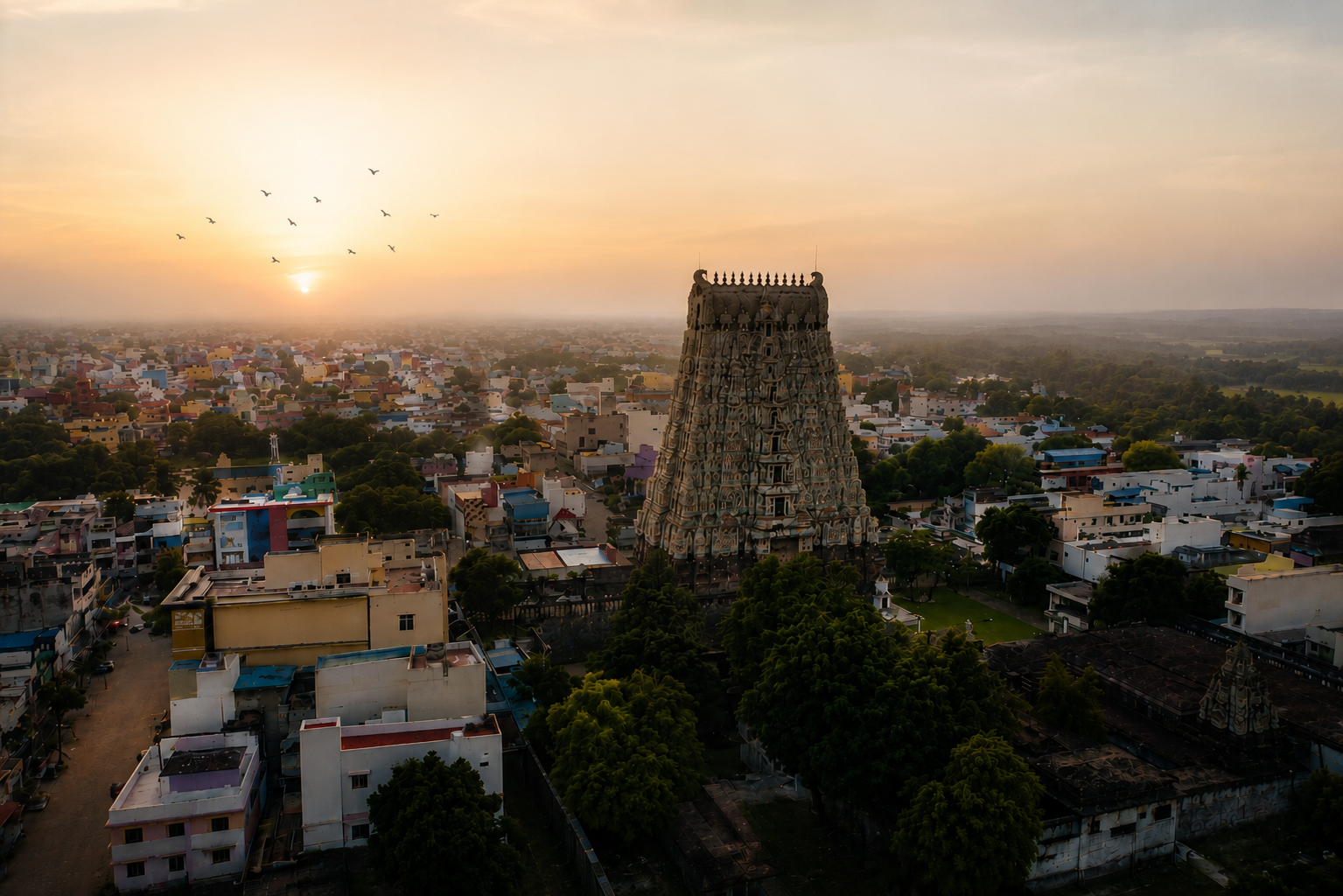
Who Built the Kasi Viswanathar Temple in Tenkasi?
The Kasi Viswanathar Temple in Tenkasi was primarily built by the Pandyan king Parakrama Pandyan (also known as Parakkirama Pandya) during the 15th century CE. However, the temple complex as seen today is the result of contributions from multiple rulers over several centuries.
Here is the definitive breakdown of its construction history:
1. The Primary Builder: King Parakrama Pandyan
The temple’s main structure is credited to Parakrama Pandyan, who ruled the southern part of the Madurai region between 1428 and 1460 CE .
- Divine Inspiration: According to temple inscriptions and legend, Lord Shiva appeared in the king’s dream and instructed him to build a temple at Tenkasi, as the original Kashi temple in the north had been damaged .
- Construction Period: Inscriptions reveal that the king began construction work in his 22nd regnal year and completed the main temple and its constituent shrines in his 39th year, a project that took about 17 years .
- Inauguration: The “karshana” or groundbreaking ceremony was performed on a specific date (1446 CE), and the temple was formally established as “Dakshina Kasi” (Kashi of the South) .
2. Major Later Contributors
The temple saw significant additions from other rulers:
- King Perumal Valudi (1505 CE): He is credited with completing the initial nine-tiered Rajagopuram (main tower), which was finished in 1505 CE .
- King Jadavarman Kulasekara Pandyan: This brother of Parakrama Pandyan helped complete the unfinished work, including the upper floors of the gopuram .
- Madurai Nayaks (16th Century): After Madurai became independent from the Vijayanagar Empire in 1559, the Nayak rulers contributed to the temple. They are known to have added the composite columns of Virabhadra and other sculptural features .
3. The Rajagopuram’s Reconstruction
The temple’s most iconic feature, its 180-foot Rajagopuram, has a history of damage and renovation:
- Original Fire (1824): The gopuram was damaged in a fire that broke out in the structure .
- Restoration (20th Century): The tower remained damaged from 1824 until 1966. Major renovation work was initiated in 1967, and the reconstruction was successfully completed in 1990, giving us the grand tower we see today .
Key Details at a Glance
| Builder/Patron | Period | Contribution |
|---|---|---|
| Parakrama Pandyan | 1428 – 1460 CE | Main temple, shrines, and primary structure |
| Jadavarman Kulasekara Pandyan | ~1473 CE | Completion of gopuram floors |
| Perumal Valudi | 1505 CE | Completion of the 9-tier Rajagopuram |
| Madurai Nayaks | 16th Century | Sculptures, pillars, and other additions |
| Hindu Religious Board | 1967 – 1990 | Reconstruction of the main tower after fire damage |
Frequently Asked Questions
Q: Is the temple mentioned in any ancient inscriptions?
A: Yes, numerous inscriptions from the 14th to 16th centuries exist within the temple, recording construction details, land grants, and royal gifts .
Q: Who originally conceived the idea of building this temple?
A: According to legend, Lord Shiva himself appeared in a dream to King Parakrama Pandyan and ordered him to build it, promising that it would be as sacred as Kashi .
Q: Why was the temple built in Tenkasi?
A: The legend states that the king was prevented from traveling to Kashi. Lord Shiva then instructed him to follow an army of ants, which led him to a self-manifested (Swayambhu) Lingam in Tenkasi, where the temple was subsequently built .
I want like a aritical . i dont ask who built this i am asking what type of stone used to build this temple in case people are search it on google my web seite and content will comes on top so give me the best informaion